
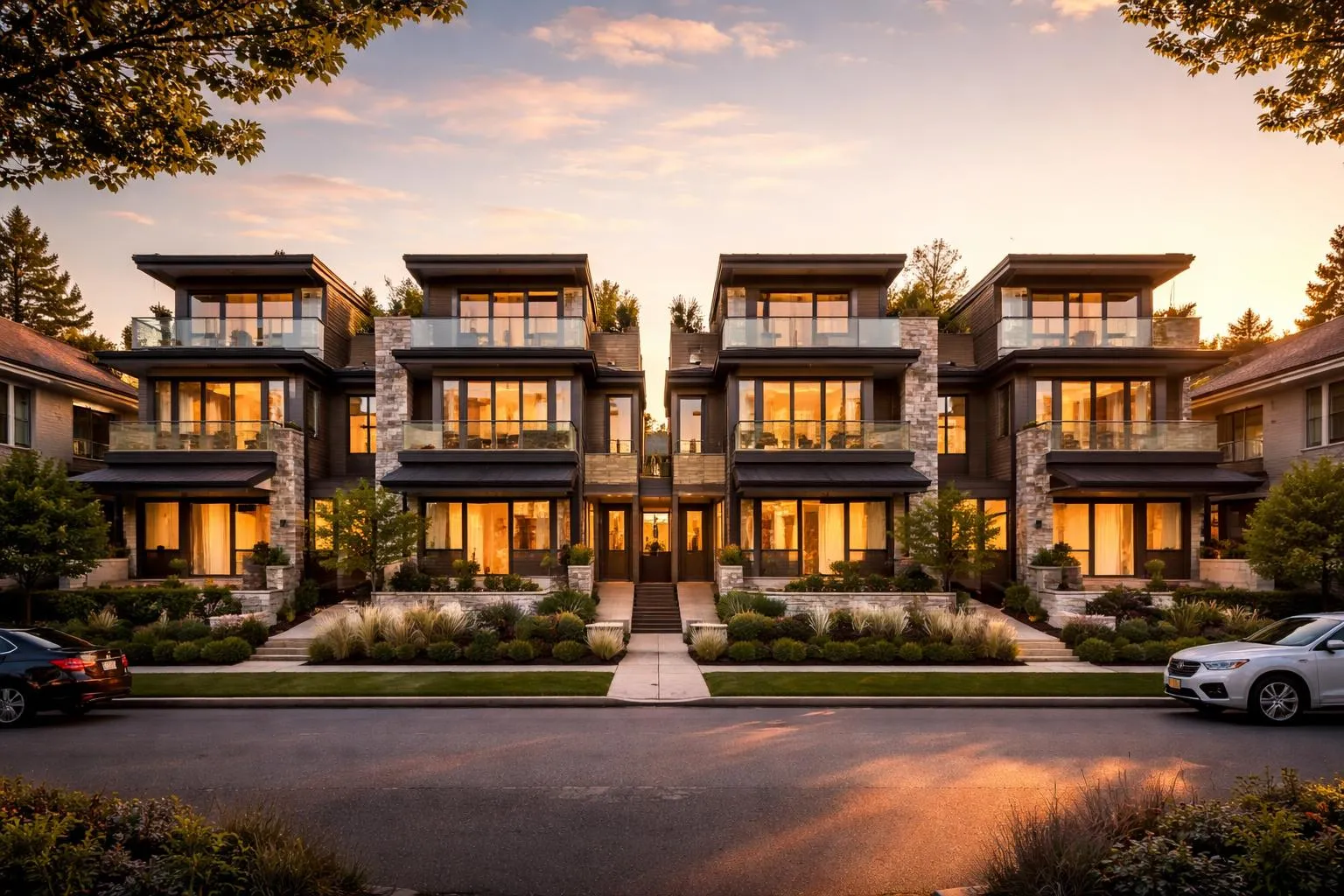
A lot of developers still make the same mistake. They assume bigger homes mean bigger profits.
In Vancouver, that logic breaks down fast.
The market in 2026 is not starving for oversized custom product. It is starved for well-planned, family-sized homes that feel elevated without drifting into a price band where the buyer pool falls off a cliff. That is the whole case for market-aligned design. Smart density beats ego density.
If you are comparing six efficient multiplex homes to three large luxury units on the same site, the winner is often the project that looks more modest on paper. Not because it is cheaper to build. In fact, smaller units can cost more per square foot once you account for extra kitchens, baths, and services. The win comes from a better match with how Vancouver buyers actually shop, what they can actually afford, and how quickly they actually make decisions.
That last point matters more than many people admit.
Start with the broad picture.
In early 2026, detached benchmark pricing across Greater Vancouver still sits around the $2 million mark, and Vancouver proper runs higher. But benchmark data can hide the real issue. Most new custom detached product is not competing at benchmark. It is competing in a much narrower luxury tier, often well above $3.5 million and sometimes past $4 million.
That is a very different market.
Public MLS activity through 2026 has kept showing a familiar pattern. Attached homes generally move faster than detached homes, and the speed gap gets wider as prices move into the custom luxury range. Sales-to-active-listings ratios have been healthier in attached product than in detached, and days on market tend to stretch once a listing enters the top end of the detached segment.
You do not need a spreadsheet obsession to see what that means.
A three-bed, two-bath multiplex home in the entry-level luxury range sits in a far deeper buyer pool than a large custom house. It may still be expensive. This is Vancouver. Nothing about ownership here feels cheap. But there is a big difference between expensive and unreachable.
That gap is where a lot of profit lives.
Absorption sounds like technical real estate jargon, but the idea is simple. How fast does the market actually take your product?
That matters because a slow exit can wreck a good-looking pro forma.
If units sell quickly, you cut carrying costs, reduce exposure to interest rate swings, shorten your marketing window, and lower the odds of price reductions. If sales drag, every month starts nibbling at your margin. Financing costs do not care that your millwork is beautiful.
This is why six smaller units can outperform three larger ones even if the larger homes seem more prestigious.
Prestige does not pay interest.
A faster-moving project often gives you a better real return, even when the margin per unit looks smaller at first glance. I have seen people fixate on gross price per door and completely miss the cost of time. That is a real mistake in Vancouver property development.
There is no magic number that works on every site. But six well-designed units often beat three oversized ones for a few very practical reasons.
A custom detached home targets a thin slice of the market. That slice gets thinner the higher you go.
A well-designed multiplex unit targets move-up buyers, families leaving condos, multigenerational households, downsizers who still want space for visiting children, and buyers who care more about function than lot size. That is a much broader base.
Broader demand usually means better absorption.
And when you are planning a Vancouver multiplex investment, demand breadth matters almost as much as pricing.
This is the part developers sometimes resist because it feels less glamorous.
A 1,200 to 1,400 square foot home with three bedrooms and two baths can land in a price range that still feels aspirational but not absurd. That is what "entry-level luxury" means in this context. Good finish quality, smart layout, enough storage, decent outdoor space, strong street appeal, but no waste.
Now compare that with a 2,300 to 2,800 square foot luxury unit. Yes, the gross ticket is higher. But each step up in price removes a chunk of your buyer pool. The drop is not linear. It gets steeper as you climb.
That is why smaller homes often achieve stronger revenue per buildable square foot. Buyers can swallow the total price, so they focus more on usability and less on sticker shock.
This is one of the hidden advantages.
When square footage is limited, bad planning becomes obvious. You cannot hide a weak layout behind a giant primary bedroom or a dramatic staircase. Every corner has to earn its keep.
That pressure often produces better homes.
The best multiplex layouts in Vancouver do a few things well:
They make the living area feel generous, not the hallway.
They keep circulation tight.
They give the kitchen enough real working room.
They make at least one bathroom genuinely comfortable.
They include storage where daily life actually needs it.
Bigger homes often waste square footage on spaces buyers rarely use. Oversized foyers. Formal dining rooms no one wants. Bonus rooms with no clear purpose. Extra powder rooms that sound impressive in a brochure and do nothing at resale.
This is the least emotional argument and probably the strongest.
If six units are designed for the thickest part of market demand, they tend to convert interest into offers faster. Faster sales mean less time holding completed inventory. Less time holding inventory means better control over your exit.
Even a great project becomes fragile if the final units sit unsold while carrying costs accumulate.
That risk gets worse in the luxury tier because buyers have options, they negotiate hard, and they rarely feel rushed. In the family-sized multiplex category, good product can still create urgency if pricing and design are right.
Here is a simple illustration. The numbers will vary by site, construction method, and submarket, but the logic is consistent.
Factor3 Luxury Units6 Smaller Multiplex UnitsAverage size per unit2,300 sq ft1,250 sq ftUnit mixLarge luxury family homes3 bed, 2 bath entry-level luxuryBuyer poolNarrowBroadExpected price bandHigher, luxury-tierLower, move-up family tierRevenue per unitHigherLowerRevenue per buildable sq ftOften lowerOften higherSales velocitySlowerFasterCarrying risk at exitHigherLowerSensitivity to market softnessHigherLower
This is the part people sometimes miss. Six smaller units may not look simpler. They usually are not. But they can be more resilient. If one luxury listing sits, one-third of your project is stuck. If one smaller unit sits, you still have multiple chances to keep momentum alive.
That matters psychologically in a sales program, and it matters financially too.
"Maximize every square foot" gets repeated so often that it starts to sound empty. In practice, it means making design choices that support resale value instead of personal taste.
Here is what that usually looks like in Vancouver.
A den with a tiny window does not fool serious buyers.
If you are marketing a family home, the bedrooms need to work as bedrooms. That means sensible dimensions, proper closet space, and enough separation from the main living area to make daily life feel sane.
Three-bed, two-bath is a sweet spot because it handles family use without loading the plan with plumbing that does not return enough value. Buyers want comfort, but they also notice when too much space gets sacrificed to secondary bathrooms.
A well-planned ensuite and a proper shared bath usually beat a layout stuffed with extra fixtures.
This sounds obvious, but a surprising number of new homes fail here.
Buyers remember the kitchen. They remember whether four people can actually sit down for dinner. They remember if the sofa wall makes sense. They do not remember that the hallway ceiling detail cost a fortune.
If the everyday spaces work, the whole home feels better.
Coats near the entry. Linen storage near bathrooms. Pantry space near the kitchen. Room for sports gear, strollers, luggage, seasonal items. Vancouver buyers notice this immediately because many are moving from tighter spaces and want the next home to feel easier.
Storage is not glamorous. It sells homes anyway.
Entry-level luxury is not bargain-basement construction with a fancy name. It still needs clean detailing, durable materials, decent appliances, good lighting, and a cohesive feel.
But there is a difference between quality and overspending.
Buyers usually pay for what improves daily use and visual confidence. They do not reliably pay back every dollar spent on exotic stone, specialty fixtures, or overbuilt feature walls. If the layout is weak, premium finishes will not save it.
This is where many projects go off course.
A developer falls in love with what they would personally want in a home and forgets that the project needs to sell into a market, not a mirror. Maybe they want a huge walk-in closet, a dramatic staircase, or a second lounge. Fine, but does the target buyer want to pay for that instead of a better kitchen, more storage, or a workable third bedroom?
Usually no.
Market-aligned design asks a harder question. What product is Vancouver short on right now, and how do we build that product cleanly?
In 2026, the answer is rarely "giant custom homes for a tiny buyer pool."
Return on investment in property development is not just about total revenue. It is about the relationship between revenue, cost, time, and risk.
Smaller multiplex units can improve that equation in several ways:
They often achieve better value per saleable square foot.
They reduce dependence on a very small luxury buyer pool.
They can shorten the sellout period.
They lower the risk tied to one unit missing its price target.
They let you spread market risk across more doors.
That does not mean every six-unit plan beats every three-unit plan. Site conditions, massing rules, parking constraints, construction complexity, and neighborhood comps still matter. I would be skeptical of anyone claiming otherwise.
But as a general investment strategy in Vancouver, smart density has a lot going for it.
There are sites where larger homes still win.
A prime west side location with a clear luxury comp set may justify bigger units. A rare view lot may support a more expensive product. Heritage constraints or awkward site geometry can also push a project toward fewer, larger homes.
So this is not an argument for density at all costs.
It is an argument for matching the design to the strongest pocket of demand.
That is the whole point. Market-aligned design is not about squeezing in units because you can. It is about choosing the form that gives you the best exit.
In Vancouver, bigger is not always better. Often, it is just slower, riskier, and aimed at the wrong buyer.
Six smaller multiplex homes can beat three luxury units because they fit the market more closely. They hit a more active price band. They attract a wider group of buyers. They waste less space. They usually give you a cleaner exit.
That is what smart property development looks like in 2026.
For anyone thinking seriously about Vancouver multiplex investment, the lesson is simple. Start with demand, not ego. Design the product people are actually waiting for. Then make every square foot prove its value.


