
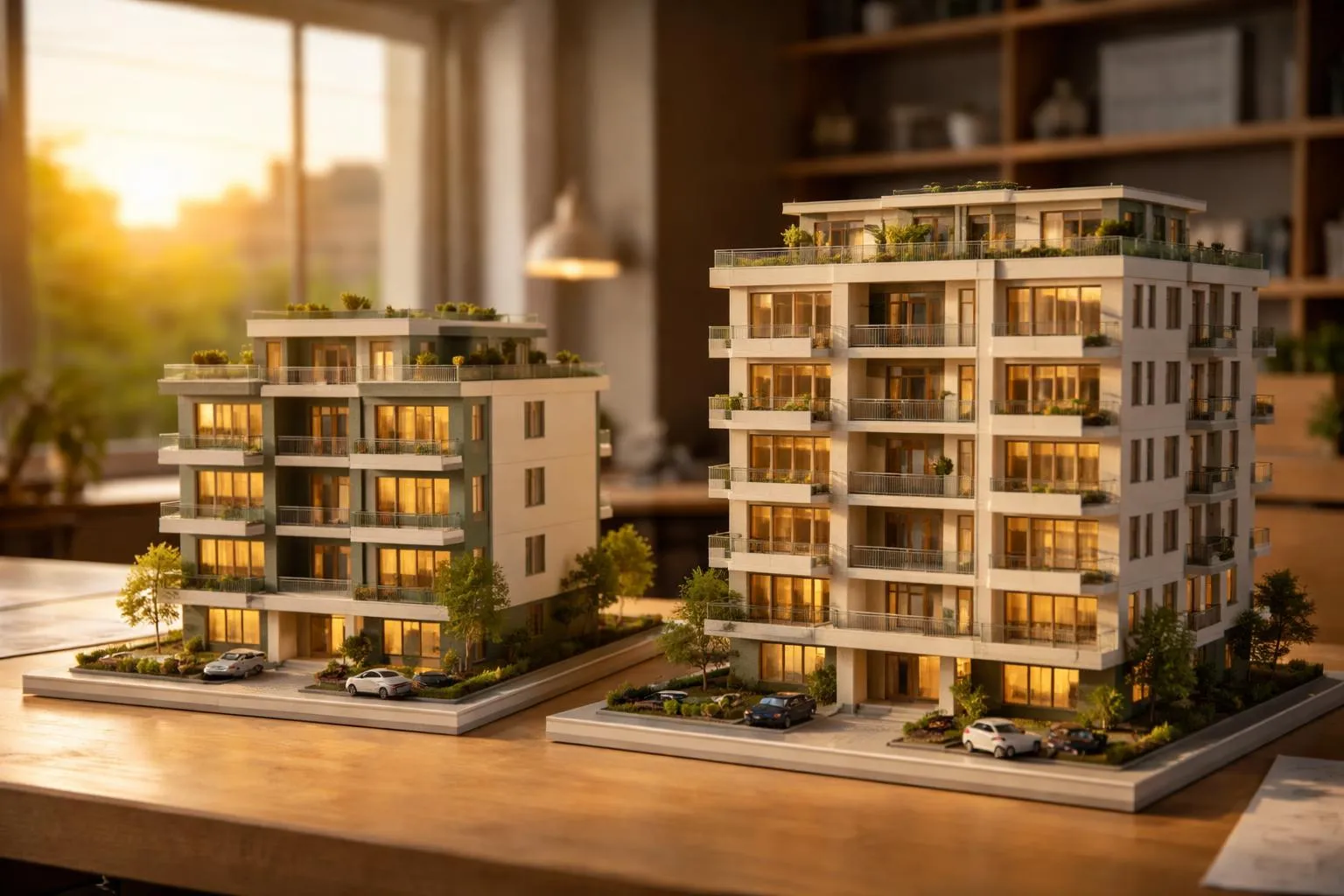
There is a habit in small and mid-scale development that looks logical on a spreadsheet and falls apart in the real world.
A site allows ten units, so the plan becomes ten units. The zoning permits a bigger building, so the design grows until it touches every limit. More doors, more square footage, more revenue. Done.
Except, not really.
Recent 2026 deal comparisons have made something plain. Some ten-unit projects are earning less than six-unit projects on the same kind of site. Not because demand disappeared. Not because the math was lazy. They underperformed because the design chased allowable density instead of buyer demand, construction efficiency, and saleability.
That difference matters more than people want to admit.
The best multiplex projects are rarely the ones that use every inch the zoning gives them. They are the ones that fit the market cleanly. They are easier to build, easier to explain, and easier to sell. In many cases, slightly smaller, better-planned three-bedroom homes move faster and produce a better return than larger or more numerous units that look better only in an early pro forma.
That is the idea behind a market-aligned approach. Start with the buyer, then work backward through design, approvals, costing, and delivery.
Zoning tells you what may be possible. It does not tell you what will perform best.
That sounds obvious, but this is where a lot of projects drift off course. A zoning bylaw can make a developer feel like they have found free value. If six units are allowed as of right and ten may be possible with clever planning, the instinct is to push for ten. Why leave density on the table?
Because density is not the same as profit.
The market does not reward effort. It does not care that a design took more consultant hours or squeezed in a harder unit count. Buyers respond to price, layout, location, and whether the home works for their life. If the project misses that, extra density can become extra friction.
I think this is one of the hardest mindset shifts in smart multiplex development. The ceiling is seductive. The market is humbling.
On paper, adding units often lifts gross revenue. In practice, it can also lift cost, schedule risk, and selling difficulty faster than expected.
Here are the usual pressure points.
Going from six units to ten is not a simple 67 percent increase in output. Sometimes it changes the building type in ways that affect almost everything:
circulation space grows
stairs and exits get more demanding
structural layouts get tighter
mechanical and electrical runs become more complicated
acoustic separation can become harder
site servicing and garbage planning get messier
common areas eat into saleable area
That last one hurts quietly. A project can look bigger overall while becoming less efficient where it counts. If more gross floor area is being spent on corridors, walls, shafts, and awkward leftover spaces, the revenue side weakens even before construction starts.
More complicated buildings tend to need more design coordination, more revisions, and more approval effort. That means more professional fees, more carrying time, and a bigger chance that one unresolved issue ripples through the whole schedule.
People often underestimate schedule risk because it feels abstract early on. It is not abstract when financing carries for longer or when sales launch into a weaker buyer window.
This is the part that gets ignored most often.
A unit mix that is technically efficient for the site may be emotionally wrong for the buyer. If pushing density means creating units that feel tight, dark, oddly shaped, or just a bit too compromised, buyers notice fast. They may not say, “This corridor ratio is poor.” They just hesitate.
And hesitation is expensive.
The same thing happens at the top end of pricing. There is usually a point where buyers stop rewarding extra square footage at the same rate. I think of it as max-size price resistance. A bigger unit may cost significantly more to build, but the market may not pay a matching premium for the added area, especially if that area does not improve day-to-day living.
A large but clumsy home can lose to a smaller, cleaner one every time.
The recent finding that some ten-unit projects underperform six-unit projects is not a weird exception. It is a reminder that revenue is only one side of the story.
A project can produce:
more total saleable units
a higher projected top-line revenue
a bigger building presence on paper
and still deliver:
lower profit margin
lower return on cost
slower sales
more exposure to delays and price negotiation
When that happens, the problem usually is not density itself. The problem is density without design discipline.
A six-unit scheme can win because it is simpler, more efficient, and closer to what buyers actually want. That means fewer construction surprises, better layouts, clearer positioning in the market, and less resistance at sale time.
This is why experienced teams do not evaluate density in isolation. They test the full chain from land fit to unit plan to exit pricing.
The phrase “smaller but better” sounds like a slogan until you look at how people actually buy homes.
Three-bedroom homes hit a broad part of the ownership market. Families want them. Multigenerational households want them. Buyers who need one bedroom as an office still want them. They offer flexibility without requiring luxury-level pricing.
But size alone is not the point. Function is.
A well-planned three-bedroom unit does a few things really well:
Buyers notice usable kitchens, real dining areas, decent storage, laundry that is not awkward, bedrooms that fit furniture, and living rooms with natural light. They do not get excited about wasted hallways or oversized transition space.
A unit can be smaller on paper and still feel better because the layout has less dead area.
Many markets have a sweet spot where homes move faster because more buyers can stretch into that range. Once pricing climbs beyond that band, the pool narrows. You may still get a sale, but it often takes longer and invites more negotiation.
That matters. Time is part of return.
Buyers do not mind paying for value. They do mind paying for bulk that does not improve livability. An extra 150 square feet sounds good until it turns into a larger hallway, a redundant flex nook, or a room that feels hard to use.
This is where max-size thinking can backfire. Bigger can raise cost without raising conviction.
If the goal is to turn a complex process into a repeatable system, the sequence matters.
Too many projects begin with, “What is the maximum we can fit?” A better question is, “What product is most likely to sell well here, at a price that supports the whole project?”
That leads to a more grounded process.
Before drawing massing options, define who the homes are for. End users are not all the same. A growing family, downsizers who still want bedrooms for visiting children, and a multigenerational household may all want different things from the same neighborhood.
This is not just about the highest sale ever recorded nearby. It is about the price range where absorption is healthy. A project that depends on every unit selling at the upper edge of local tolerance is fragile.
Once you know the likely buyer and realistic price band, unit size and layout become clearer. This is where many teams realize that moderately sized three-bedroom units beat a more crowded mix or oversized premium units.
Good design is not only about aesthetics. It is about keeping the building rational. Clean structural logic, simpler servicing, lower circulation loss, and repeatable details often protect margin better than squeezing in another unit.
If the project cannot be described simply, that is usually a warning. Clear homes for a clear buyer tend to perform better than designs that need a lot of explanation.
This is the heart of smart multiplex development. It is less glamorous than density-chasing, but it is far more dependable.
Imagine a site where two concepts are possible.
The first scheme fits ten units. The second fits six.
The ten-unit version looks better at first glance. More units mean more gross revenue. But fitting ten requires a more complicated layout, more common area, tighter bedrooms, and extra construction coordination. The average unit lands in an uncomfortable middle ground. Too small to feel generous, too expensive to feel like a bargain.
The six-unit version does something less flashy. It creates efficient three-bedroom homes with better light, cleaner layouts, and a price point that sits inside a wider buyer pool. The building is simpler to construct. Net saleable efficiency improves. Sales are easier to launch because the product is easier to understand.
Now imagine the numbers.
The ten-unit project projects higher gross revenue, but costs rise sharply and sales drag. Discounts appear. Carrying costs stay longer. Margin ends up thin.
The six-unit project brings in less top-line revenue, but it costs meaningfully less to build and sells with less resistance. Margin is better. Return on cost is better. Stress is lower too, which does not show up in a spreadsheet but matters plenty.
This is not hypothetical in spirit, even if every site will differ. It is exactly the kind of outcome the recent comparisons have exposed.
Most underperforming multiplex projects are not bad because of one giant mistake. They are bad because of a stack of small, believable assumptions.
It is not. Every extra unit has a cost in design, buildability, approvals, and marketability.
A larger home is only more valuable if the added area improves the way people live in it.
A design can work physically and still miss the local buying range.
If the building gets bulkier but the homes get weaker, the extra area is not helping.
By the time a project is deeply drawn, teams become attached to it. That is human. It also makes course correction expensive.
If you are testing a multiplex concept, these questions can save a lot of pain later:
Who is the most likely buyer for each unit type?
What total price range moves fastest in this pocket?
How much of the building becomes non-saleable circulation?
Does adding units trigger a jump in construction complexity?
Are the bedrooms genuinely usable, or just counted?
Would a slightly smaller unit feel better if the plan were cleaner?
How sensitive is the project to slower sales or modest price cuts?
Can the project be explained in one sentence without sounding defensive?
That last one is underrated. If the sales pitch starts with “yes, but,” the product may already be fighting itself.
People often talk about development as if success comes from spotting opportunity first. That matters, sure. But repeatable results usually come from something less dramatic. A disciplined process.
The most reliable projects connect the whole chain:
site selection, zoning review, concept design, constructability, costing, approval strategy, pricing, and buyer fit.
When those steps talk to each other early, you get better decisions. When they do not, the project becomes a series of handoffs, and each handoff adds friction.
This is why “turning complex process into repeatable system” is more than a nice phrase. In multiplex work, it is practical. You need a method that stops the team from falling in love with density before testing whether the market wants the product that density creates.
Sometimes the smartest move is to build fewer homes.
That can feel conservative. It is not. It is disciplined.
There is nothing wrong with pursuing density when the site, design, and buyer demand support it. Some projects should be pushed harder. Others should not.
The mistake is assuming the answer is always “more.”
A better project is the one that fits the market, the site, and the build. Sometimes that means six units, not ten. Sometimes it means trimming square footage so the layout works better. Sometimes it means choosing functional three-bedroom homes over a plan that looks bigger but sells harder.
Zoning tells you what you can do. The market tells you what you should do.
The gap between those two is where good judgment lives.


