
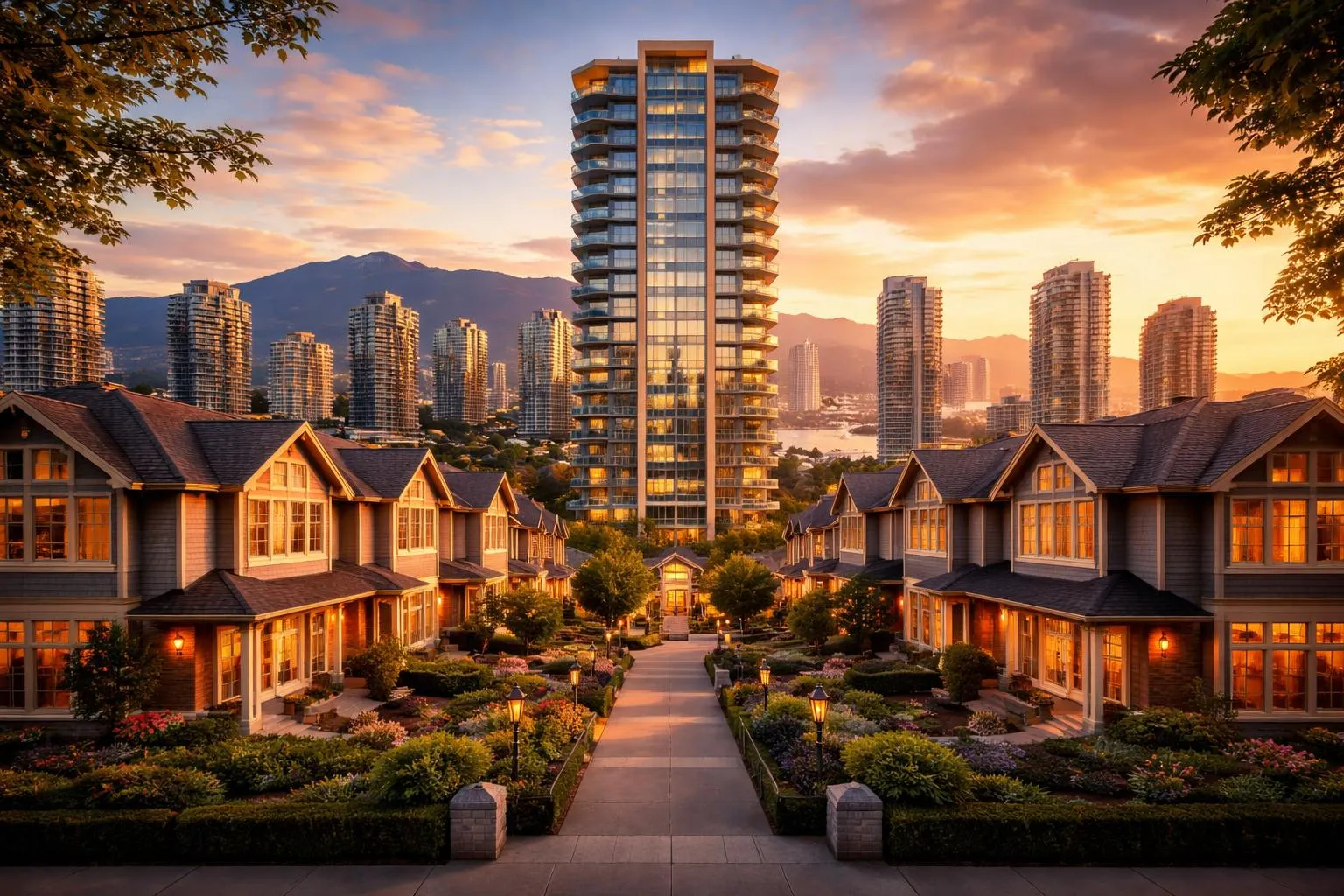
If you have been watching Vancouver real estate this year, the split is hard to ignore. Condos have softened. Townhomes have not softened nearly as much. Detached homes, while never exactly cheap, are still holding up better than many people expected.
That matters because broad market headlines can flatten what is really a two speed market.
Current 2026 data points tell a clear story: condo prices are down 7.8% year over year, while townhomes and detached homes have shown much more stability. When one property type is slipping and another is holding, investors should stop treating "real estate" like one big bucket. It is not. Product type matters. Buyer profile matters. Financing matters. In a city like Vancouver, those details can make or break the thesis.
So what is causing the condo squeeze, and why are townhomes getting through it better?
A big part of the answer is mortgage renewals. A lot of investor-owned condos were bought when debt was cheaper and monthly carrying costs felt manageable. Those loans are now resetting at higher rates. For owners who were already operating on thin margins, the math is no longer comfortable. Some are selling, and that extra supply is putting pressure on condo prices.
Townhomes, duplexes, row homes, and small multiplex properties are in a different position. They sit in a part of the market people often call the Missing Middle. That term gets overused, but the idea is simple: housing that gives buyers more space than a condo, at a lower cost than a detached house. In Vancouver, that format makes a lot of sense. Families want it. Move-up buyers want it. Downsizers often want it too, if the layout works.
If you are thinking about investment strategies in Vancouver, this is the kind of market where nuance pays.
Let’s start with the obvious part. Condos are usually the most accessible entry point into Vancouver real estate. Lower price points bring in more buyers, but they also attract more investors. That mix can work well in lower-rate periods. It gets shaky when financing costs jump.
Here’s what tends to happen when renewals bite:
Owners who financed at older rates are facing a very different payment today. Even if the property looked fine on paper a few years ago, a higher renewal rate can change the holding cost in a hurry. Some owners can absorb that. Some cannot.
When many people face the same pressure at once, more units hit the market. More listings usually mean more negotiating room for buyers, which pushes prices down.
One reason condos can wobble more than low-rise housing is simple supply logic. In many parts of Metro Vancouver, condo inventory can build up quickly in clusters. New towers, similar floor plans, similar finish packages, similar amenities. Buyers compare one unit against ten others in the same postal code and sometimes in the same building category.
That creates competition between sellers. If several owners need to sell around the same time, price becomes the lever.
A townhome buyer may stretch for a better layout, a better school catchment, or a private outdoor space. Condo buyers are often comparing tighter margins. If one unit has a higher strata fee, a worse orientation, or a noisier exposure, it can get punished faster.
In a softer market, those details stop being minor.
Many condo buyers are lifestyle buyers, but a meaningful slice of the market is still more price-sensitive and more transaction-sensitive. That means demand can pause more abruptly when rates rise or economic confidence dips.
This is not a permanent indictment of condos. Condos still have a place. They can work well in the right location, at the right basis, with the right building quality. But right now, the segment is carrying more stress.
Townhomes are not immune to rate pressure. Nothing is. But they tend to have a deeper pool of practical buyers.
That practical demand matters more than people think.
A lot of buyers want more than a one-level layout. They want bedrooms separated from living space. They want a front door that opens to the outside. They want room for a stroller, a bike, visiting parents, a small office, or just a bit of breathing room.
In Vancouver, detached houses are out of reach for many households. Townhomes fill that gap. They are not a compromise in the same way a condo can feel like one for some buyers. For many people, they are the real target.
That gives the product more support.
Low-rise, ground-oriented housing is hard to produce cheaply in Vancouver. Land costs are high. Approvals take time. Construction is expensive. When you combine all that, it becomes harder for the market to flood itself with true family-oriented ground-access homes.
Scarcity is not everything, but it helps.
This part gets missed in spreadsheets. Utility matters. A well-planned townhome can serve more life stages than a typical condo. Young couples buy them. Growing families buy them. Multigenerational households consider them. Some older owners downsize into them if the design is accessible enough.
That wider buyer base often supports resale value better during uneven markets.
The Missing Middle is one of those planning terms that can sound abstract. It is not abstract at all when you are trying to decide where to invest.
It generally includes housing types between high-rise condos and detached homes: townhomes, duplexes, triplexes, fourplexes, row houses, courtyard homes, and small multiplex buildings.
Why does that category matter so much in Vancouver right now?
Because it matches the city’s affordability reality better than detached homes, while offering more livability than many condos.
That is a strong middle position.
People still need space. They still care about neighborhood quality, schools, transit access, parks, and daily convenience. But many cannot or will not pay detached-home prices. Missing Middle housing meets that demand in a more natural way than towers do for a big share of buyers.
From an investment standpoint, that creates a different risk profile. You are not only betting on market appreciation. You are buying into a housing form that solves a real usage problem.
That tends to age better.
The honest answer is yes, but not blindly.
If someone asks, “Is Vancouver a good place to invest in real estate?”, I would say the city still has strong long-term fundamentals. Land is limited in key areas. Population pressure does not disappear. Desirable neighborhoods stay desirable. Transit-oriented communities keep drawing attention. People want to live here, even when the numbers are frustrating.
But a good city is not the same as a good deal.
That distinction matters a lot in 2026.
In this market, the better question is not whether Vancouver is investable in general. It is where inside Vancouver the risk-adjusted opportunity is strongest. Right now, that looks less like generic condo exposure and more like well-located Missing Middle housing with broad appeal to end users.
That does not mean every townhome is a winner. Some are poorly built. Some have awkward layouts. Some are priced as if they are detached homes with a shared wall, which defeats the whole value proposition.
Still, if you are comparing product types, townhomes and multiplex-style homes are giving investors a better margin of safety than many condos.
If you are weighing options, step away from the sales pitch and use a simple scorecard. I like plain questions better than fancy models.
This is probably the most useful filter.
Ask yourself: if you needed to sell in a choppy market, who would still want this property?
A generic one-bedroom condo in a crowded micro-market may attract price-sensitive buyers who have many alternatives. A three-bedroom townhome near schools, parks, and transit often draws buyers with a more specific need. Need-based demand tends to be steadier than preference-based demand.
Recent comparables matter, but forward supply matters too.
For condos, check how many similar units are competing nearby. Look at active listings, not just solds. Look at projects under construction and planned completions. A pretty price chart can hide incoming pressure.
For townhomes and multiplex homes, ask a different question: how many close substitutes really exist in that neighborhood? Sometimes the answer is “not many,” which is useful.
This sounds small. It is not small at all.
Two properties with the same square footage can perform very differently if one wastes space. Long hallways, tiny second bedrooms, narrow kitchens, poor storage, no outdoor connection, and strange stair placement all hurt buyer appeal.
Efficient layouts support value because people feel the difference the moment they walk in.
For condos, strata fees can change the whole picture. Amenities that look attractive in photos can become a long-term cost drag. Building age, maintenance history, and insurance issues deserve real scrutiny.
For townhomes and multiplexes, look carefully at strata structure if one exists, common maintenance obligations, parking practicality, and how private the outdoor areas actually feel.
Friction adds up.
A softer condo market does not mean “never buy condos.” That would be too neat, and the market is never that neat.
There are still cases where condos can make sense:
Buildings with unusually strong locations and limited direct competition
Larger units with functional family-friendly layouts
Boutique low-rise projects in established neighborhoods
Units bought at a true discount relative to replacement cost and nearby alternatives
Properties with very strong walkability and transit utility
The point is selectivity. In a falling or flat condo segment, average stock tends to stay average. You need a real edge, either in price, location, or property quality.
If you cannot explain that edge in one minute, keep looking.
Townhomes get most of the conversation, but small multiplex housing is worth a harder look too.
A well-located duplex, triplex, or fourplex style property can benefit from many of the same forces that support townhomes. It offers more space, a more house-like experience, and a tighter supply profile than standard condo inventory. It also fits the direction many municipalities are moving in, which is to allow more homes on single lots while avoiding a high-rise-only model.
That policy shift does not guarantee returns. Policy never does. But it does mean this housing type is moving closer to the center of how cities expect to grow.
When a product type fits both buyer demand and planning direction, I pay attention.
This is the part where people get themselves in trouble.
Many investors still think in old categories. “Condos always recover first.” “Entry-level units are safest.” “Anything in Vancouver goes up eventually.”
Maybe. But maybe not on your timeline, and not at your purchase price.
Price per square foot is helpful, but it can also mislead. Buyers do not live in a spreadsheet. A slightly higher price per square foot for a much better layout, better privacy, or better neighborhood access may be the smarter buy.
In some condo pockets, buyers are tired of sameness. Same finish palette. Same narrow floor plan. Same promise of lifestyle. When buyers get fatigued, they become choosier.
Townhomes often escape that problem because the use case is more concrete.
Some townhomes are fantastic. Some are glorified stacked units with weak privacy, awkward access, and heavy common-area obligations. The label is not enough. You still need to assess design, location, build quality, and market fit.
If I had to boil current investment strategies down to one idea, it would be this: buy the housing type that solves the most stubborn problem for the most likely future buyer.
In Vancouver, that problem is often the gap between condo living and detached-home pricing. Missing Middle housing sits right in that gap. That is why it has more resilience right now.
A practical 2026 lens might look like this:
Favor homes with broad end-user appeal over homes that rely on perfect market conditions
Prioritize usable space over flashy but inefficient design
Be wary of segments with rising resale supply and lots of close substitutes
Focus on neighborhoods where demand is tied to daily life, not hype
Keep underwriting conservative, because refinancing and carrying costs still matter
That is not flashy advice. I know. But flashy advice is usually expensive.
The condo squeeze is real. Prices falling 7.8% year over year tell you this is more than a few isolated weak buildings. Higher mortgage renewals are pushing some investor-owned units onto the market, and that pressure is showing up in resale numbers.
Townhomes and other Missing Middle housing are telling a different story. They are holding up better because they meet a more durable kind of demand. People want space, flexibility, and a path between condo living and detached-home prices. That need is not going away.
So where should you park your capital now?
In this version of the Vancouver market, I would lean toward well-located townhomes and thoughtfully chosen multiplex properties before I would chase a typical condo. Not because condos are finished. They are not. But because the margin for error is tighter there, and the buyer pool for good ground-oriented housing is still doing a lot of heavy lifting.
That is the real lesson in 2026. Real estate is not one market. It is a set of smaller markets with different stress points. Investors who treat it that way usually make better decisions.


